The Virtual Library of Serbia is a system linking member libraries that actively work in the system. In addition to the National Library of Serbia, the Matica Srpska Library, the University Library in Belgrade, and the Yugoslav Bibliographic-Information Institute have played a key role in the system since its very beginning. The VBS Centre is one of the sectors operating within the National Library of Serbia. It has departments for redaction of the main E-catalogue, system maintenance, helpdesk, library development and training. The VBS Centre is based on the COBIB.SR union bibliographic/ catalogue database, which is being created by 700 cataloguers with the permit for cataloguing from 112 libraries. It is impossible to plan the transition to the COBISS3 environment with certainty primarily due to unstable financial situation.
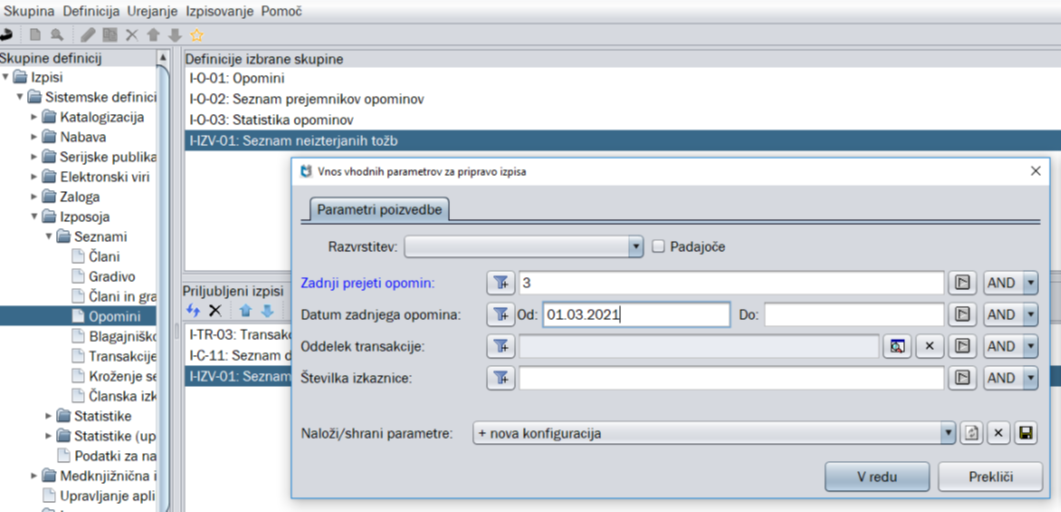
Kranj City Library is one of the largest Slovenian public libraries, which, like most Slovenian libraries, also deals with the debts of its users. Prohit Claims Management Agency helps us to collect the debts. Before collection by an external contractor, we first carry out a series of procedures in the library to collect the debts ourselves. We regularly monitor the debts of library users and inform them about their debts.
The article presents in detail the data on the annual increment of bibliographic records in 2020 at annual and monthly levels. The analysis includes 185,518 bibliographic records created by 545 cataloguers from 247 libraries. In the last quarter of the year, 30.4% of bibliographic records were created.
In 2020, IZUM released the first version of the COBISS Digital Repository (dCOBISS), which is an independent web app, intended for storing and managing digital content. It is available to all libraries in the COBISS system and it works by principles of shared access to publications in dCOBISS.
User experience is becoming an increasingly important aspect of the quality of services, products and even bibliographic information systems. Due to the lack of comprehensive research into user experience in bibliographic information systems, we developed a questionnaire, covering all key dimensions and aspects of user experience and taking into account the specificities of bibliographic information systems.
In Slovenia, 301 libraries and 689 cataloguers with permits for shared cataloguing of monographs participate in shared cataloguing. The article presents the annual increment of bibliographic and authority records in COBIB.SI in 2019.
In 2019, the Public Library of Užice conducted a survey to assess the level of user knowledge of the search process in COBISS/OPAC (now COBISS+). The survey consisted of the following segments: user profile, most commonly used access points, use of screen tips and ease of searching, and user evaluation of the search results obtained.
The amendments to the Librarianship Act in 2015 redefined the status of school libraries and assigned new tasks associated with the monitoring of the activities and development of school libraries to the National and University Library (NUL). The statistical monitoring of activities performed by school libraries, the designing of the school library development strategy, the concept of three-year development plans and the development of regulations on the conditions to be met by school libraries in the field of education are among the new activities of the Library System Development Centre, NUL.
The article presents an analysis of the increase in bibliographic records in COBIB.SI in 2018. The data collected during the year were included in the analysis. Emphasis is placed on bibliographic data (n = 169,226), as well as data on the increase of normative records for personal names in the CONOR.SI database (n = 63 716) and data on downloaded records from other databases. Included is the analysis of the increment of bibliographic records by months for 2018 and the most productive days of the year.
As one of the segments of data quality analysis, theoretical and methodological approaches towards measuring the quality of data in bibliographic and authority records are presented. On the basis of professional literature review, the paper focuses on metrics, methods of measurement and results analysis.
We use cookies to ensure that we give you the best experience on our website. If you continue to use this site we will assume that you are happy with it.